
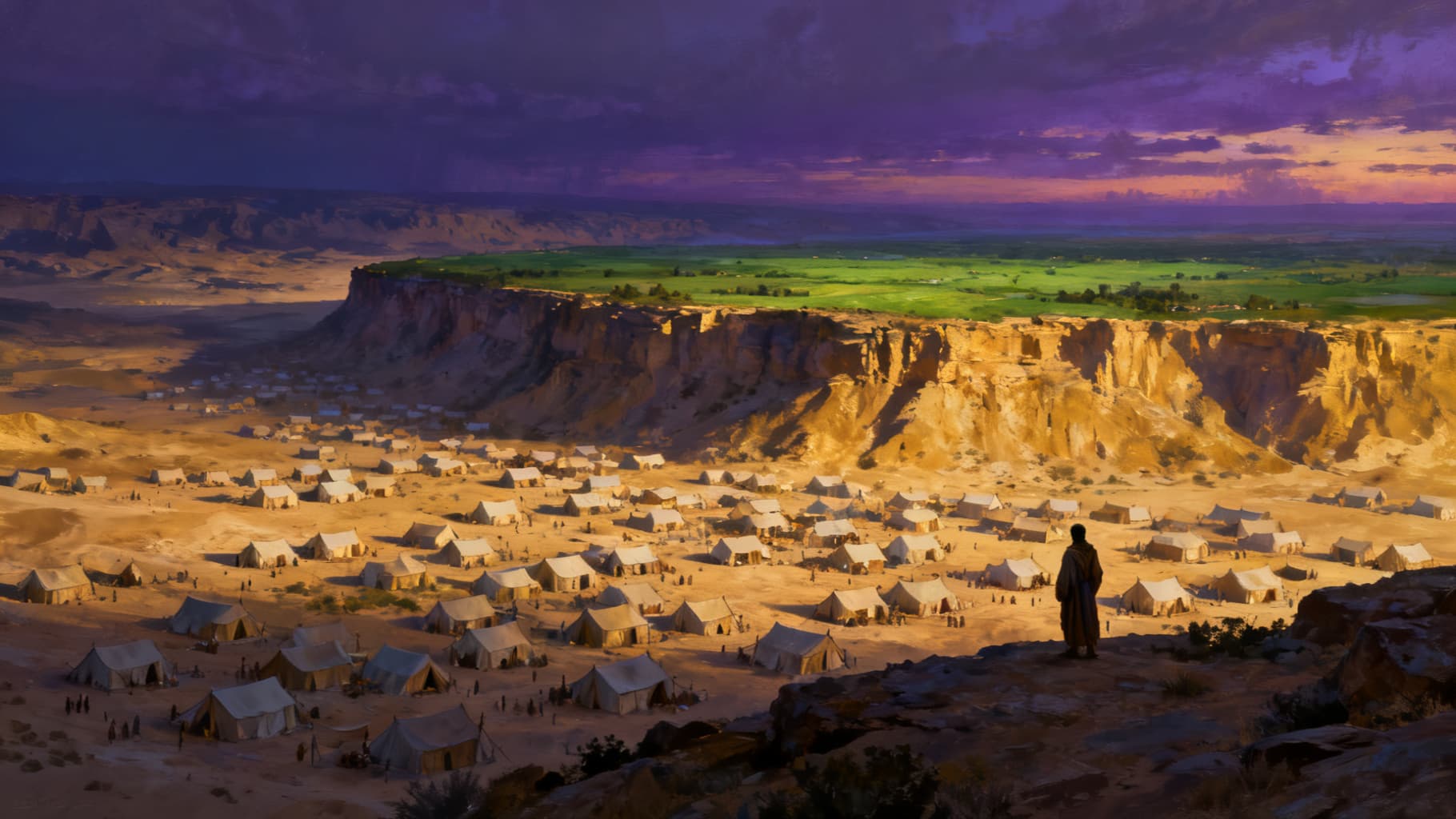
Forty Years
The Rest They Could Not Enter
Numbers 13 · Numbers 14 · Deuteronomy 8
“Remember how the Lord your God led you all the way in the wilderness these forty years, to humble and test you.”
— Deuteronomy 8:2 (NIV)
Israel stands at Kadesh-barnea, at the very threshold of everything God had promised. Twelve representatives go in and survey the land, and they return carrying its fruit — proof that the promise is real and good. The land is exactly what God said it would be. Nothing about His word has failed. What follows is not a failure of the promise but a failure to believe it.
Ten of the spies report the obstacles honestly enough — fortified cities, formidable people — but then make the fatal move from observation to conclusion: “We are not able.” Caleb and Joshua see the identical landscape and reach the opposite verdict: “The Lord is with us; do not fear them.” The dividing line is not courage as a personality trait but faith as a way of reckoning reality. To leave God out of the calculation is, functionally, to call Him absent.
The congregation believes the report of unbelief. They weep through the night, accuse God of bringing them out to die, and propose appointing a leader to take them back to Egypt — back to the very bondage from which He had redeemed them. This is the deep irony Scripture keeps returning to: the heart that will not trust God will romanticize its former slavery rather than risk His promise.
The sentence is sobering. That generation will not enter; they will wander until they pass, and their children — the very ones they feared would become plunder — will inherit instead. Hebrews names the root with precision: “they were not able to enter because of unbelief.” Not weakness, not the giants, not bad logistics. Unbelief was the sin that barred the door. The promise stood open the whole time; faith was the only thing that could walk through it.
Yet the forty years are not merely punishment; they are formation. Deuteronomy 8 reframes the whole stretch: God “humbled you, causing you to hunger and then feeding you with manna… to teach you that man does not live on bread alone but on every word that comes from the mouth of the Lord.” He gave daily bread precisely so they would learn daily dependence. Their clothes did not wear out; their feet did not swell. The wilderness was a school of trust, where provision came one morning at a time and the whole path was never visible at once.
It is worth sitting with how the New Testament carries this. Hebrews 3–4 takes the wilderness generation as a standing warning to the church — “Today, if you hear his voice, do not harden your hearts” — and insists that “a Sabbath-rest still remains for the people of God.” The promised land becomes a figure of the deeper rest we enter by faith and forfeit by unbelief. And Jesus, led into His own wilderness for forty days, answers the tempter with this very text — “man shall not live on bread alone” — succeeding in the desert exactly where Israel failed, the faithful Son who enters the rest and brings His people in.
So the story holds two truths in tension that we need together. Unbelief is not a minor flaw; it can keep us standing at the edge of a promise we never enter. And the God we are slow to trust is faithful in the very wilderness our unbelief creates — humbling, testing, feeding us one day’s manna at a time until dependence becomes second nature. The invitation is not to admire Caleb’s courage from a distance but to refuse the hardened heart today, and to step in.
The Big Idea
The promise never failed — unbelief barred the door. Caleb and Joshua read the same giants and trusted God; the rest romanticized their old slavery and wandered forty years. Yet God made the wilderness a school of daily dependence, and Scripture says the rest still remains for those who enter by faith.
Reflect & Discuss
- 1.Where are you currently reading the obstacles honestly but reckoning God out of the equation — moving from “this is hard” to “we are not able”?
- 2.What old “Egypt” do you find yourself romanticizing when trusting God forward feels too costly?
- 3.Hebrews calls unbelief the thing that barred the door. Where might a quietly hardening heart be keeping you from a rest God is holding open?
- 4.How is God using a present wilderness to teach you to live on “every word from His mouth” rather than on bread alone?
A Prayer
Father, the land was good and the promise was sure, and still they would not believe — and I see that same unbelief in me, dressed up as realism. Guard my heart from hardening. Give me the faith that reckons You into every fear, and the humility to receive Your provision one day at a time. Thank You that a rest still remains, and that Jesus succeeded in the wilderness where I would have failed. Lead me in, and let me follow. Amen.
Talk It Through
Chat about Forty Years and receive Scripture-based encouragement rooted in this story.
Ask anything about this story to get started.
This AI guide offers encouragement, not counseling, and can make mistakes, so always test what you read against Scripture.
Emergency: call 911, or call/text 988.
Journey Through the Bible
Stop 18 of 83
Up next: When God Defends the Disrespected
The same story, told for…