
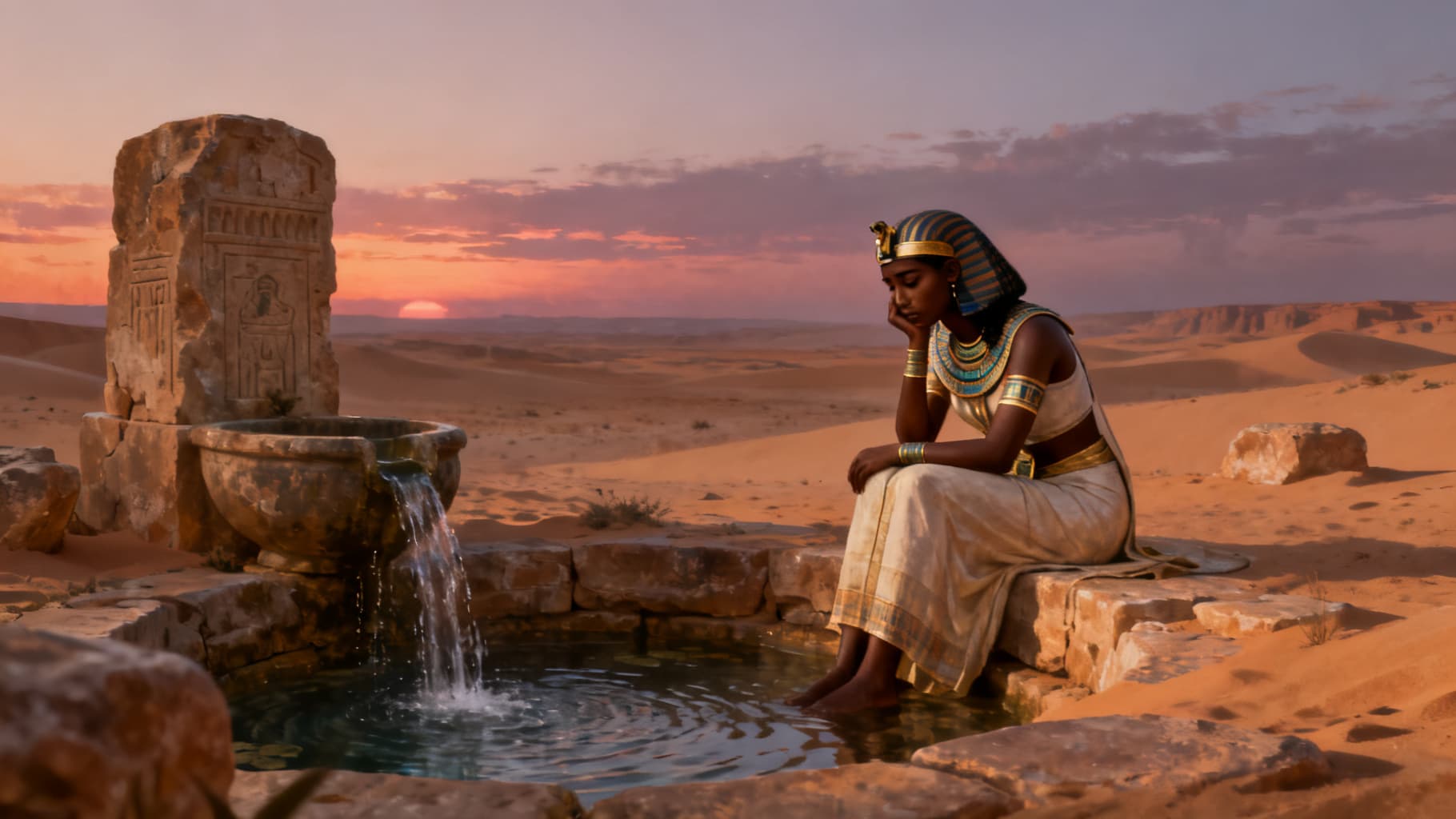
“You are the God who sees me.”
— Genesis 16:13 (NIV)
Hagar is named in Scripture as an Egyptian — an African woman — and a servant in the household of Abram and Sarai. She enters the story not as an agent but as an instrument: when Sarai despairs of bearing a child, Hagar is given to Abram to produce an heir. She is used to solve a problem that is not hers, and when the arrangement breeds resentment, the blame and the harsh treatment fall on her.
Mistreated and pregnant, Hagar does what the powerless often do — she flees, with nowhere to go. She ends up in the wilderness by a spring on the road back toward Shur, toward Egypt, toward home. She is a foreigner, a slave, a woman, and a runaway: about as far down the social ladder of the ancient world as a person could be.
And it is here, to this person, that the angel of the LORD appears — the first such appearance recorded in all of Scripture. Not to the patriarch, not to the chosen heir, but to a marginalized Egyptian servant in the desert. The God of Abraham seeks out the overlooked foreigner first, and He addresses her by name and by status: “Hagar, slave of Sarai, where have you come from, and where are you going?”
What follows is one of the most quietly radical moments in the Bible. Hagar — outsider, servant, woman — becomes the first person in Scripture to give God a name. She calls Him El Roi, “the God who sees me,” and marvels, “I have now seen the One who sees me.” The naming of God, an act of profound intimacy and authority, is entrusted to the very person the world refused to see.
We should not soften the texture of this. Hagar's situation is not resolved into ease; the angel sends her back to a hard household, and her road remains difficult. God's seeing does not always remove the wilderness. But it transforms it — because she is no longer invisible, no longer merely a means to someone else's end. She has been seen, named, and given a future.
The story is not finished in chapter 16. In Genesis 21, cast out for good with her son Ishmael, Hagar sits down a bowshot away because she cannot bear to watch the boy die of thirst. And God hears, and opens her eyes to a well, and keeps His covenant promise to make of Ishmael a great nation. The God who sees is also the God who provides for the foreigner He has not forgotten.
For us, Hagar's story confronts the human habit of looking past people — the worker, the immigrant, the servant, the one used and discarded. Scripture insists that God's gaze runs in the opposite direction, resting first on the overlooked outsider. To worship El Roi is to learn to see the people we are tempted not to see, and to trust that when our own wilderness makes us feel invisible, we are fully known and fully seen.
The Big Idea
God reveals Himself first to a mistreated Egyptian servant in the desert, and lets her name Him ‘the God who sees me.’ He sees the overlooked outsider — and calls us both to trust that we are seen, and to see those the world looks past.
Reflect & Discuss
- 1.Who in your life is being treated as an instrument rather than a person — and have you truly seen them?
- 2.Why do you think God chose a foreign servant woman for His first recorded appearance of the angel of the LORD?
- 3.Hagar was seen but still sent back to a hard place — how do you hold the truth that God's care does not always remove the wilderness?
- 4.Where do you most need to know, today, that you are seen and named by God?
A Prayer
Father, You are El Roi, the God who sees. You sought out a mistreated foreigner in the desert and called her by name — so I trust that You see me, even in the wilderness where I feel invisible and used. Give me Your eyes for the overlooked, the outsider, the one the world passes by. Help me to see them, and to trust that You have never lost sight of me. Amen.
Talk It Through
Chat about Hagar and the God Who Sees and receive Scripture-based encouragement rooted in this story.
Ask anything about this story to get started.
This AI guide offers encouragement, not counseling, and can make mistakes, so always test what you read against Scripture.
Emergency: call 911, or call/text 988.
Journey Through the Bible
Stop 7 of 83
Up next: The Lord Will Provide
The same story, told for…