
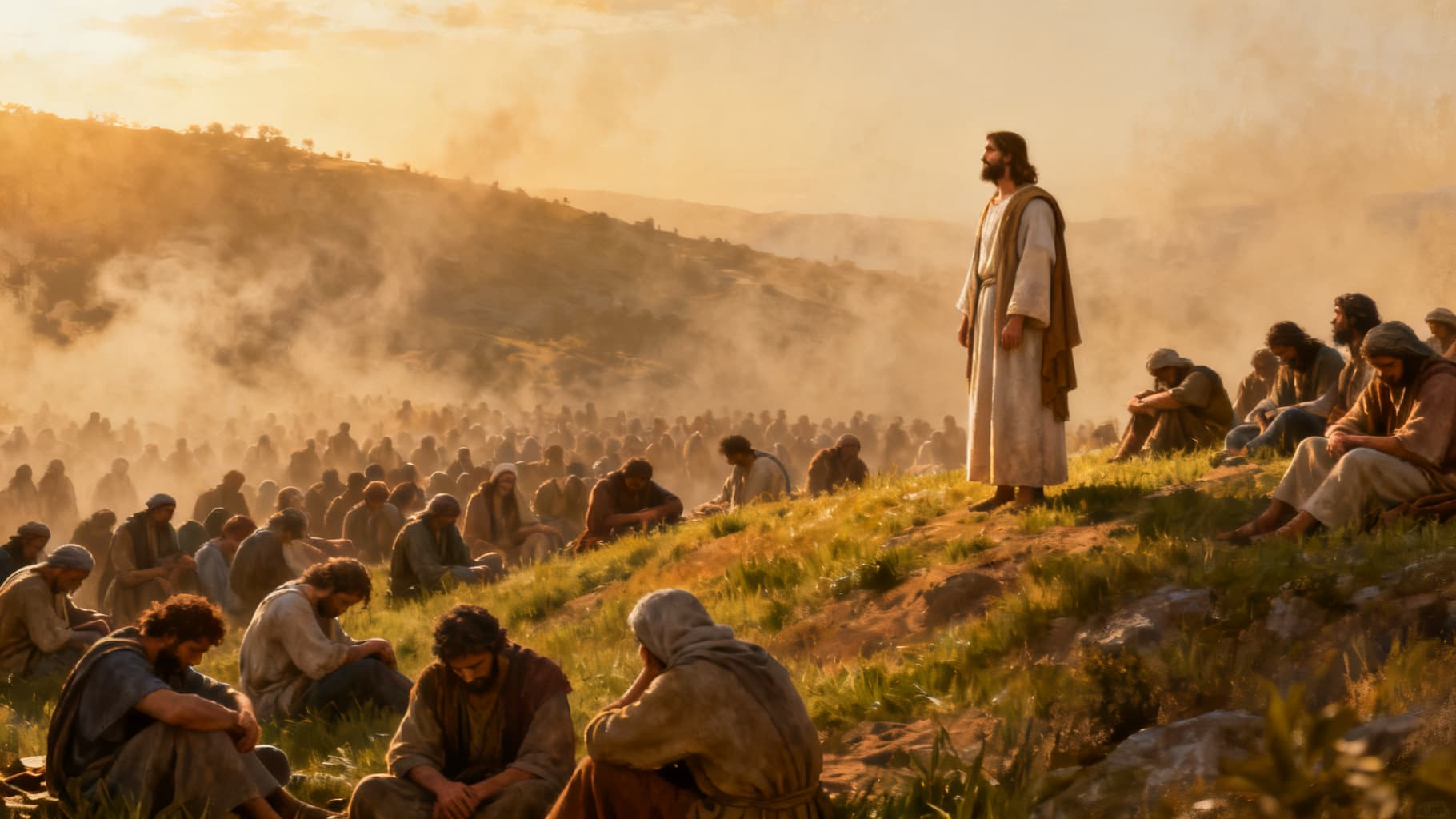
“Taking the five loaves and the two fish and looking up to heaven, he gave thanks and broke the loaves.”
— Mark 6:41 (NIV)
The feeding of the five thousand is the only miracle, apart from the resurrection, recorded in all four Gospels — a sign the early church refused to forget. It begins not with spectacle but with compassion. Mark tells us Jesus looked at the crowd and was moved because they were “like sheep without a shepherd.” The miracle is born out of his attentiveness to ordinary human need.
The disciples, by contrast, do the responsible thing: they assess the situation and conclude it can’t be done. Eight months’ wages wouldn’t buy enough bread. Send the people away. Their logic isn’t faithless so much as small — it measures the need against the budget and stops there. Much of our own anxiety lives in exactly that arithmetic.
Then Jesus reframes the problem: “You give them something to eat.” He invites them to bring whatever they actually have into the equation, and what they have is almost nothing — five loaves and two fish, a boy’s lunch. It is a deliberately absurd amount. The point is that the resource is never the variable that determines the outcome.
Watch the verbs, because they are the heart of the story: Jesus took the bread, gave thanks, broke it, and gave it. Took, blessed, broke, gave. These are the same four movements that will reappear at the Last Supper and at the table in Emmaus. This is the grammar of the kingdom: what is taken up, surrendered in gratitude, and offered back is what God multiplies.
And multiply it he does — not stingily, but with leftovers. Twelve baskets remain, one for each disciple, as if to press the lesson personally into the hands of those who had just declared it impossible. The God who provides does not merely meet the need; he answers scarcity with abundance, and gives his servants the evidence to carry home.
There is a deeper sign here, which John unfolds in the rest of the chapter: the One who feeds the crowd is himself the Bread of Life. Physical provision points beyond itself to the deeper hunger only Christ satisfies. The miracle is real, and it is also a parable about where true sustenance is found.
For us, the invitation is to stop disqualifying our small offerings. Our limited time, modest means, ordinary gifts — placed in his hands with thanksgiving rather than withheld in fear — become the raw material of provision for others. The kingdom’s economy is not addition but multiplication, and it begins the moment we hand over our loaves.
The Big Idea
Provision in the kingdom doesn’t depend on the size of your resources but on whether you place them in Christ’s hands. Offer your little with thanksgiving — taken, blessed, broken, and given, it multiplies.
Reflect & Discuss
- 1.Where are you measuring a need against your budget and concluding, like the disciples, that it can’t be done?
- 2.What “five loaves and two fish” are you withholding because they seem too small to matter?
- 3.How does the pattern of took–blessed–broke–gave reshape the way you hold your time, money, and gifts?
- 4.Where do you need to let physical provision point you back to Christ as the deeper bread your soul is hungry for?
A Prayer
Lord Jesus, I so easily measure the need against what I have and decide it’s impossible. Forgive my small arithmetic. Here are my loaves and fish — my time, my means, my ordinary gifts. Take them, bless them, break them, and give them, and feed others through what little I bring. You are the Bread of Life; satisfy my deepest hunger in You. Amen.
Talk It Through
Chat about Jesus Feeds 5000 People and receive Scripture-based encouragement rooted in this story.
Ask anything about this story to get started.
This AI guide offers encouragement, not counseling, and can make mistakes, so always test what you read against Scripture.
Emergency: call 911, or call/text 988.
Journey Through the Bible
Stop 60 of 83
Up next: The Father Who Runs
The same story, told for…