
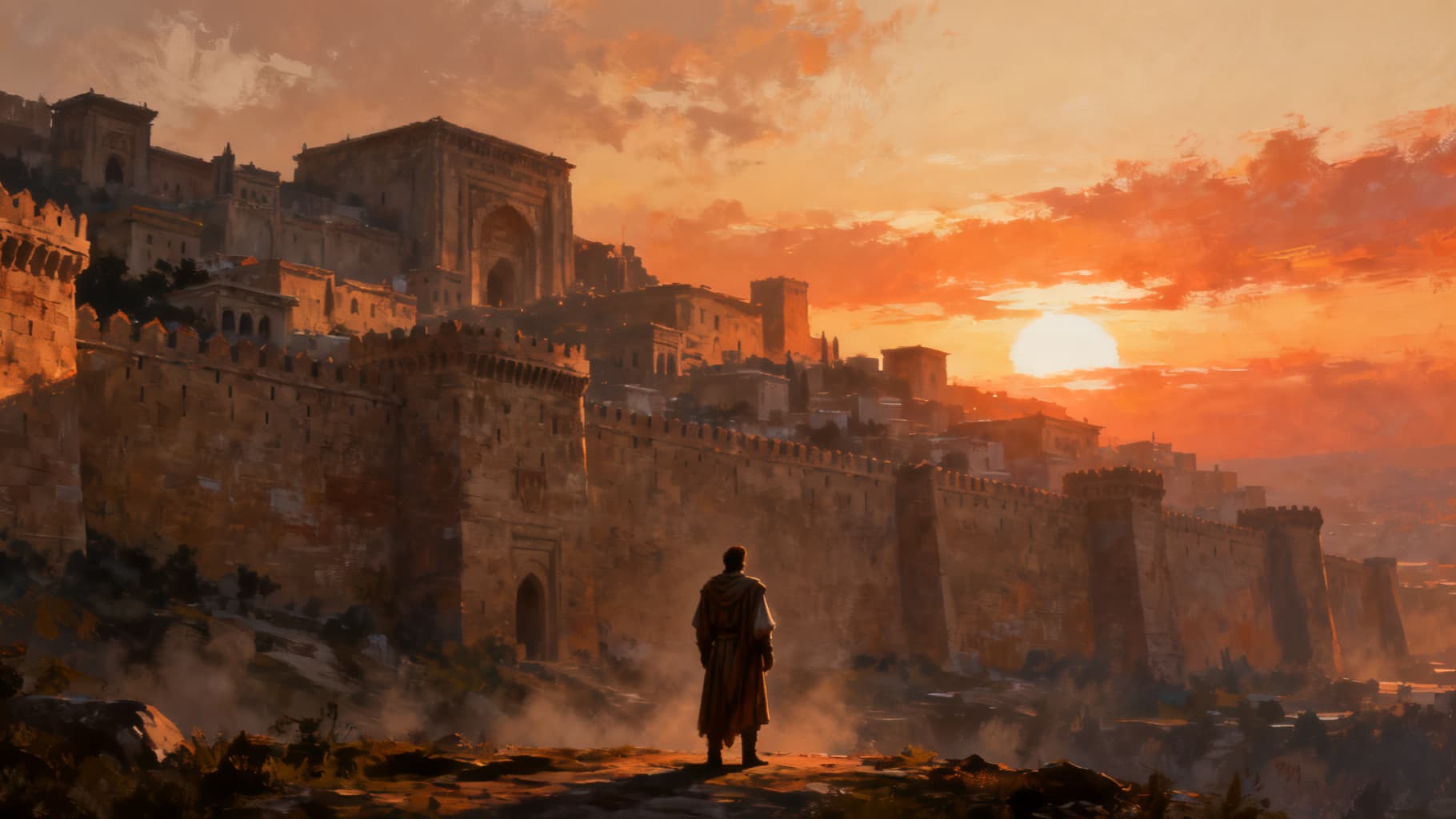
“When the trumpets sounded, the army shouted, and… the wall collapsed; so everyone charged straight in, and they took the city.”
— Joshua 6:20 (NIV)
Joshua inherits leadership in the long shadow of Moses — the deliverer, the lawgiver, the man who spoke with God face to face. Stepping into that vacancy is its own kind of crisis, and God’s first words to Joshua address it directly: three times He commands, “Be strong and courageous,” and grounds the courage not in Joshua’s competence but in His presence and His Word.
Notice that the courage is tethered to obedience. God tells Joshua to “be careful to obey all the law” and to keep the Book of the Law on his lips and in his meditation day and night. Biblical courage is never raw nerve; it is confidence in a God whose instructions can be trusted even when they cannot be explained.
And the instructions for Jericho strain that trust to its limit. This is the first major conquest in the land, and God’s battle plan is liturgy, not strategy: a procession, the ark, seven priests with trumpets, a daily circuit of the city for six days in silence. Militarily it is absurd. That is precisely the point — the plan is designed so that no one could mistake the outcome for human achievement.
Then there is the discipline of the seven days. God could have flattened the walls on the first morning, but He calls His people to march in faith before the breakthrough comes. Six days of obedient, repetitive, seemingly fruitless effort precede the seventh. Much of the spiritual life is lived in those six days — faithful obedience without visible results, learning that we walk by faith and not by sight.
On the seventh day the rhythm intensifies — seven circuits, the trumpet blast, the shout — and only then do the walls fall. Hebrews 11 reads the moment plainly: “By faith the walls of Jericho fell, after the army had marched around them for seven days.” The shout was an act of faith offered before there was any evidence it would work; the collapse was God’s answer to that faith.
Crucially, the victory was announced as already given before a single stone moved: “See, I have delivered Jericho into your hands.” Israel did not earn the city; they received it. Their marching did not cause the walls to fall — their obedience simply positioned them to participate in what God had already determined to do. The triumph, start to finish, belonged to the Lord.
For adults who lead, build, and carry responsibility, Jericho reframes how we pursue results. We are tempted to trust our strategies, our effort, our ability to engineer outcomes. God invites a harder and freer path: obey before you understand, persevere through the unspectacular middle, and hand Him the credit and the outcome — because the walls were always His to bring down.
The Big Idea
Faith often looks like obeying a plan you cannot explain and persevering through the days before the breakthrough — trusting that the victory was God’s to give all along.
Reflect & Discuss
- 1.Where is God asking you to obey before you understand — and what makes that hard to do?
- 2.Are you in a ‘seventh day’ or one of the unspectacular six? How do you stay faithful in the marching?
- 3.Where are you tempted to trust your own strategy and effort instead of God’s instructions?
- 4.What would it look like to truly hand God both the credit and the outcome of the work in front of you?
A Prayer
Father, I like plans I can understand and results I can engineer. Teach me the obedience of Joshua — to trust Your Word, to march faithfully through the days before any breakthrough, and to remember that the victory was always Yours to give. Make me strong and courageous, and keep me close to You. Amen.
Talk It Through
Chat about Joshua Takes Charge and receive Scripture-based encouragement rooted in this story.
Ask anything about this story to get started.
This AI guide offers encouragement, not counseling, and can make mistakes, so always test what you read against Scripture.
Emergency: call 911, or call/text 988.
Journey Through the Bible
Stop 20 of 83
Up next: God Uses the Unlikely to Shame the Strong
The same story, told for…