
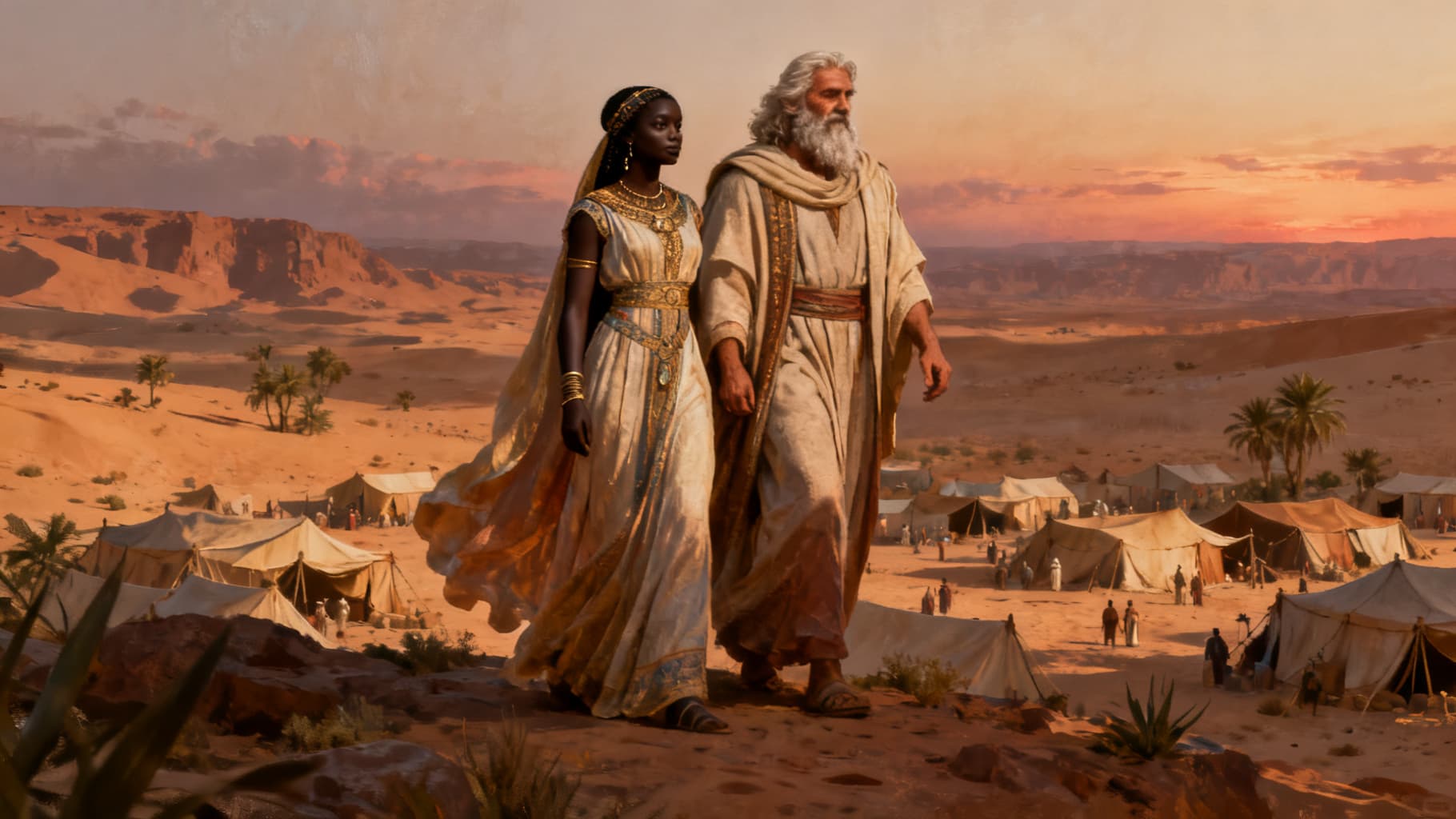
Moses, His Cushite Wife, and Miriam
When God Defends the Disrespected
Numbers 12
“The anger of the Lord burned against them, and he left them.”
— Numbers 12:9 (NIV)
Numbers 12 opens with a sentence the church has too often hurried past: “Miriam and Aaron began to talk against Moses because of his Cushite wife, for he had married a Cushite.” Cush is Black Africa — the region of the upper Nile, Nubia, the land of modern Sudan and Ethiopia. Moses’ wife is a Black African woman, and Scripture says so without apology. The text does not require us to recover what it never hid.
What is being recovered is the nature of the offense. The grievance begins “because of his Cushite wife.” Whatever else Miriam and Aaron dress it up as, the root is contempt for a marriage to a Black African woman — prejudice over ethnicity and color. This is not a modern reading imposed on an innocent text; it is the text’s own stated starting point.
Observe how the prejudice cloaks itself. Their next words are not about her at all: “Has the Lord spoken only through Moses? Hasn’t he also spoken through us too?” The bias hides behind a question of spiritual authority and standing. It is one of Scripture’s sharpest portraits of how bigotry operates — never naming its real motive, always borrowing a more respectable one. The misuse of “spiritual” status to mask a fleshly contempt is itself the sin God exposes.
And God exposes it swiftly. He summons the three to the Tent of Meeting, vindicates Moses’ unique standing and faithfulness, and His anger burns; “he left them.” The Lord does not treat this as a minor family squabble or an understandable preference. He treats the disrespect of this marriage — and of this woman — as something that provokes divine wrath. Heaven does not stay neutral about prejudice.
Miriam is struck with a skin disease, white as snow, and is shut outside the camp for seven days. The judgment carries a terrible irony for any reader who is paying attention: the one who held another’s appearance and origin in contempt is herself altered in appearance and put outside the community. The instinct to exclude is answered, for a season, with exclusion.
Yet the chapter does not end in retribution but in intercession. Aaron pleads, and Moses — the very man slandered, whose wife was scorned — cries out, “Please, God, heal her!” The most powerful response to contempt here is not vengeance but the offended party’s prayer for the offender’s restoration. Humility is the thread running through the whole account; the narrator even pauses to call Moses “very humble, more than anyone else on the face of the earth.”
For us, the application is direct and uncomfortable. We are practiced at the very move Numbers 12 condemns: justifying bias with theology, with “standards,” with concern for order, when the real issue is that someone is the wrong color or from the wrong place. This passage tells us where God stands. He defends the disrespected, He rebukes the leaders who looked down on her, and He calls His people to a humility that honors every image-bearer — and refuses to let spiritual language launder a prejudiced heart.
The Big Idea
Scripture itself confronts prejudice: God defends Moses’ Black African wife, rebukes the contempt aimed at her, and exposes the way bias hides behind spiritual language. Examine your own heart, and let humility — not status — govern how you treat every person.
Reflect & Discuss
- 1.Where might you, like Miriam and Aaron, be using a “spiritual” or principled-sounding reason to cover an actual bias?
- 2.What does it mean for your view of God that His anger burned over contempt for a Black African woman’s place in His leader’s family?
- 3.Moses prayed for the very sister who scorned his wife — where is God calling you to intercede instead of retaliate?
- 4.How does genuine humility reshape the way you treat people of a different ethnicity, color, or background?
A Prayer
Father, You did not stay silent when Your servant’s wife was held in contempt — You defended her, and Your anger burned against the prejudice. Search me for the bias I have hidden behind good reasons and holy words. Give me the humility of Moses, who interceded for the one who wronged him, and teach me to honor every person You have made. Amen.
Talk It Through
Chat about Moses, His Cushite Wife, and Miriam and receive Scripture-based encouragement rooted in this story.
Ask anything about this story to get started.
This AI guide offers encouragement, not counseling, and can make mistakes, so always test what you read against Scripture.
Emergency: call 911, or call/text 988.
Journey Through the Bible
Stop 19 of 83
Up next: Obeying Before You Understand
The same story, told for…