
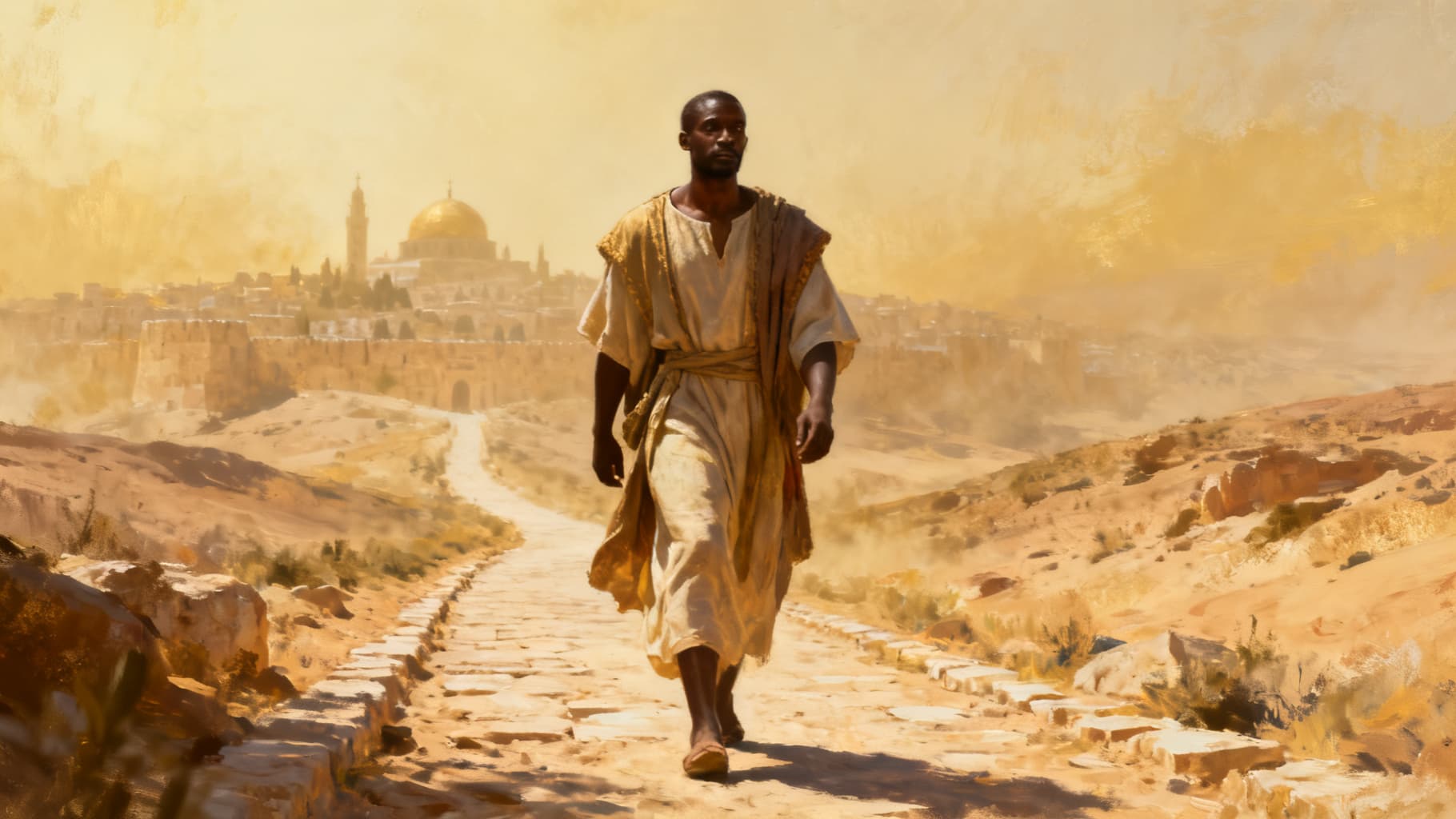
Simon of Cyrene Carries the Cross
The Man Who Carried the Cross
Matthew 27 · Mark 15 · Luke 23
“As the soldiers led him away, they seized Simon from Cyrene… and put the cross on him and made him carry it behind Jesus.”
— Luke 23:26 (NIV)
He enters the Gospels in a single sentence and never speaks. Simon of Cyrene — a North African Jew who had come from the coast of present-day Libya up to Jerusalem for Passover — is conscripted by Roman soldiers, mid-journey, to carry the cross of Jesus. The narrative does not pause to ask his permission. Compelled, he steps to the center of the most consequential procession in history.
It matters, and we should say it plainly, that the man at the physical center of the passion is an African. The Gospel writers did not have to record his origin; they did. Cyrene is North Africa, and Simon stands as a permanent witness that Africa is not a footnote to the gospel but woven into its very heart — present at the cross, carrying its weight on African shoulders.
There is a piercing irony in the timing. Not long before, Jesus had taught, “Whoever wants to be my disciple must deny themselves and take up their cross and follow me.” The disciples who heard those words have fled. And now a stranger from Cyrene does, with literal wood on his back, exactly what the metaphor described — he takes up the cross and walks behind Jesus. Simon embodies discipleship at the precise moment the disciples have scattered.
Consider, too, the shape of providence here. Simon did not set out that morning to participate in the redemption of the world; he set out to keep a feast. The defining moment of his life arrived as an interruption — an inconvenience forced on him by an occupying power. Much of what God does in a life comes disguised as something we would never have chosen, arriving sideways through what feels like intrusion.
The detail that betrays the interruption’s fruit is almost offhand. Mark names Simon “the father of Alexander and Rufus” (Mark 15:21), assuming his readers know them — and Paul later greets a Rufus in Rome, “chosen in the Lord,” along with his mother (Romans 16:13). It is a reasonable inference that the man compelled at the cross carried something home, and that his household became known and beloved in the early church. The forced labor of an afternoon appears to have seeded a family’s faith.
We should resist sentimentalizing his suffering — the cross was an instrument of horror, and Simon’s burden was real and heavy. Scripture refuses gratuitous detail and so should we. But the theological weight is unmistakable: the One who came to bear the sin of the world allowed, for a stretch of road, the help of a single African man, and in doing so dignified every believer who would ever be asked to carry what they did not choose.
Simon’s witness invites a steady, adult reflection. The cross you are handed may not be the cross you would have selected. It may arrive as conscription rather than calling. Yet the road to Golgotha runs, for a time, through the shoulders of an ordinary man from Cyrene — proof that God positions the unsuspecting at the heart of his purposes, and that obedience under compulsion can become a legacy carried for generations.
The Big Idea
Simon, the North African pulled from the crowd, became the literal embodiment of ‘take up your cross and follow me.’ Providence often arrives as interruption — and the burden you did not choose can become the legacy you leave.
Reflect & Discuss
- 1.Where has a defining work of God in your life arrived disguised as an interruption you resented?
- 2.What does it mean that the man at the physical center of the passion was an African from Cyrene — and how does that reshape how you picture the gospel?
- 3.Simon literally did what the disciples had only heard described. Where are you hearing ‘take up your cross’ as metaphor when God means it concretely?
- 4.Simon’s afternoon seems to have shaped his household for generations. What might you be carrying now whose fruit you will not see?
A Prayer
Father, You placed an African stranger at the very heart of the cross and made his burden holy. When You hand me weight I did not choose, keep me from resentment; let me carry it behind Jesus as Simon did. Use the interruptions of my life for purposes I cannot yet see, and let what I carry bless those who come after me. Amen.
Talk It Through
Chat about Simon of Cyrene Carries the Cross and receive Scripture-based encouragement rooted in this story.
Ask anything about this story to get started.
This AI guide offers encouragement, not counseling, and can make mistakes, so always test what you read against Scripture.
Emergency: call 911, or call/text 988.
Journey Through the Bible
Stop 73 of 83
Up next: The Hope That Changes Everything
The same story, told for…