
“Villagers in Israel would not fight; they held back until I, Deborah, arose, a mother in Israel.”
— Judges 5:7 (NIV)
The book of Judges turns on a relentless cycle: Israel sins, God hands them over to an oppressor, they cry out, and God raises up a deliverer — only for the people to forget and begin the spiral again. The Deborah account opens squarely inside it. Israel has done evil, and for twenty years Jabin of Canaan and his commander Sisera, with nine hundred iron chariots, have cruelly oppressed them. The cry goes up, and God answers — but the deliverer He raises is not who the ancient world would have predicted.
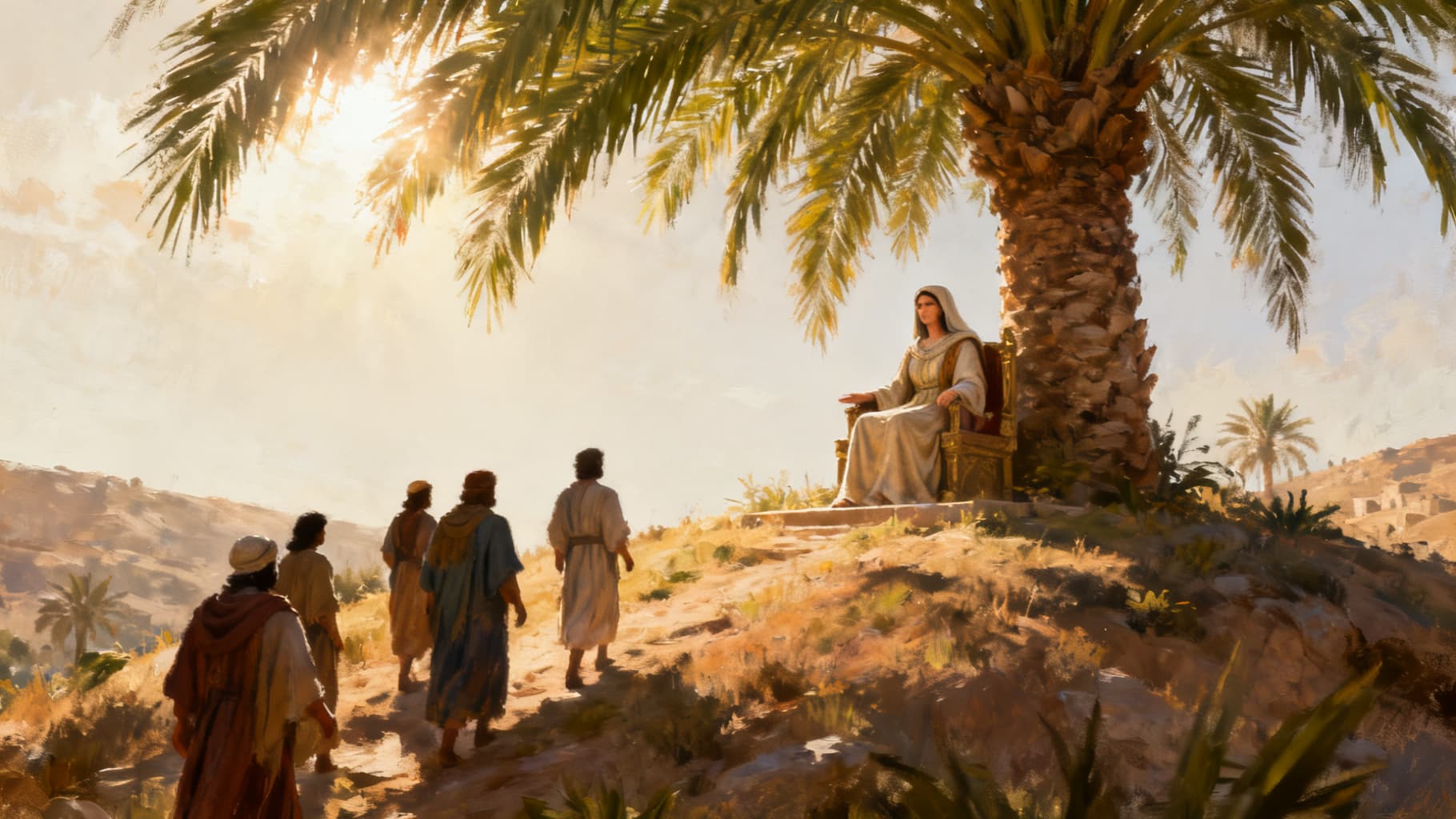
Deborah is introduced as a prophet and the judge leading Israel at that time — a woman holding the highest spiritual and civil authority in a thoroughly patriarchal age. She sits under her palm, the people come to her for judgment, and she hears God clearly. Before a single soldier moves, the narrative has already signaled its theme: God is at work through the one the culture would least expect to see in charge.
She summons Barak and delivers God’s command with a general’s clarity — march on Mount Tabor, and the Lord will lure Sisera and his chariots to the Kishon and hand them over. Barak’s reply is telling: “If you go with me, I will go; but if you don’t go with me, I won’t go.” It is not simple cowardice so much as a faith that needs a prop. Deborah agrees to go, but announces that the road he has chosen will route the glory away from him — “the Lord will deliver Sisera into the hands of a woman.”
And so He does. God Himself routs Sisera; the text says the Lord threw the army into confusion, and the dreaded iron chariots — the very symbol of superior force — become liabilities in the mud of a flooded valley. Sisera abandons his men and flees on foot, the mighty commander reduced to a fugitive, and meets his end in the tent of Jael, a woman who acts decisively when the moment is handed to her. The two figures who frame the deliverance are both women; the armed professional is sidelined.
This is no incidental detail — it is the point, and it runs straight through Scripture. “God chose the weak things of the world to shame the strong,” Paul writes, so that no human being might boast before Him. The overlooked judge, the unexpected woman in the tent, the chariots undone by rain: God repeatedly stages His victories so that the credit cannot land anywhere but on Him. The strong are shamed not out of cruelty but to dismantle the lie that power saves itself.
Judges 5 — the Song of Deborah, one of the oldest poems in the Bible — interprets the whole event in worship. It praises the LORD as the true warrior, honors the tribes who rose up and rebukes those who “held back” and stayed comfortable, and celebrates the courage of those who acted. The victory is consistently credited upward: not to Deborah’s leadership or Jael’s nerve in the end, but to the God who marched out and fought for His people.
For us the convergence is bracing. God still hears the cry of the oppressed and still raises up deliverers from the margins — and He still asks whether we will be among those who “rise up” or among those who hold back where it’s safe. The Deborah story refuses to let us locate our security in chariots, credentials, or conventional power. The battle belongs to the LORD, and He is glorified precisely by winning it through the people the world overlooked.
The Big Idea
God answers the cry of His oppressed people, and He delights to deliver them through the overlooked and the unlikely — so the glory lands on Him, not on chariots or credentials. The call is to rise up and trust that the battle belongs to the Lord, rather than holding back where it’s comfortable.
Reflect & Discuss
- 1.The Song of Deborah honors those who “rose up” and rebukes those who “held back” — which are you, and where?
- 2.Where are you tempted to trust “iron chariots” — power, status, security — instead of the God who hands victory to the unlikely?
- 3.Whom has God placed in front of you that the culture overlooks, and might He be raising up through them?
- 4.What does it look like, concretely, to live as though “the battle belongs to the Lord” in a situation you’re currently anxious about?
A Prayer
Lord, You hear the cry of the oppressed and You raise up deliverers from the places the world overlooks. Forgive me for holding back where it was safe, and for trusting in chariots of my own making. Make me quick to rise up when You call, willing to be the unlikely one You use, and content for the glory to be Yours alone. The battle belongs to You — teach me to fight from that confidence. Amen.
Talk It Through
Chat about Deborah and Jael and receive Scripture-based encouragement rooted in this story.
Ask anything about this story to get started.
This AI guide offers encouragement, not counseling, and can make mistakes, so always test what you read against Scripture.
Emergency: call 911, or call/text 988.
Journey Through the Bible
Stop 21 of 83
Up next: Strength Made Perfect in Weakness
The same story, told for…