
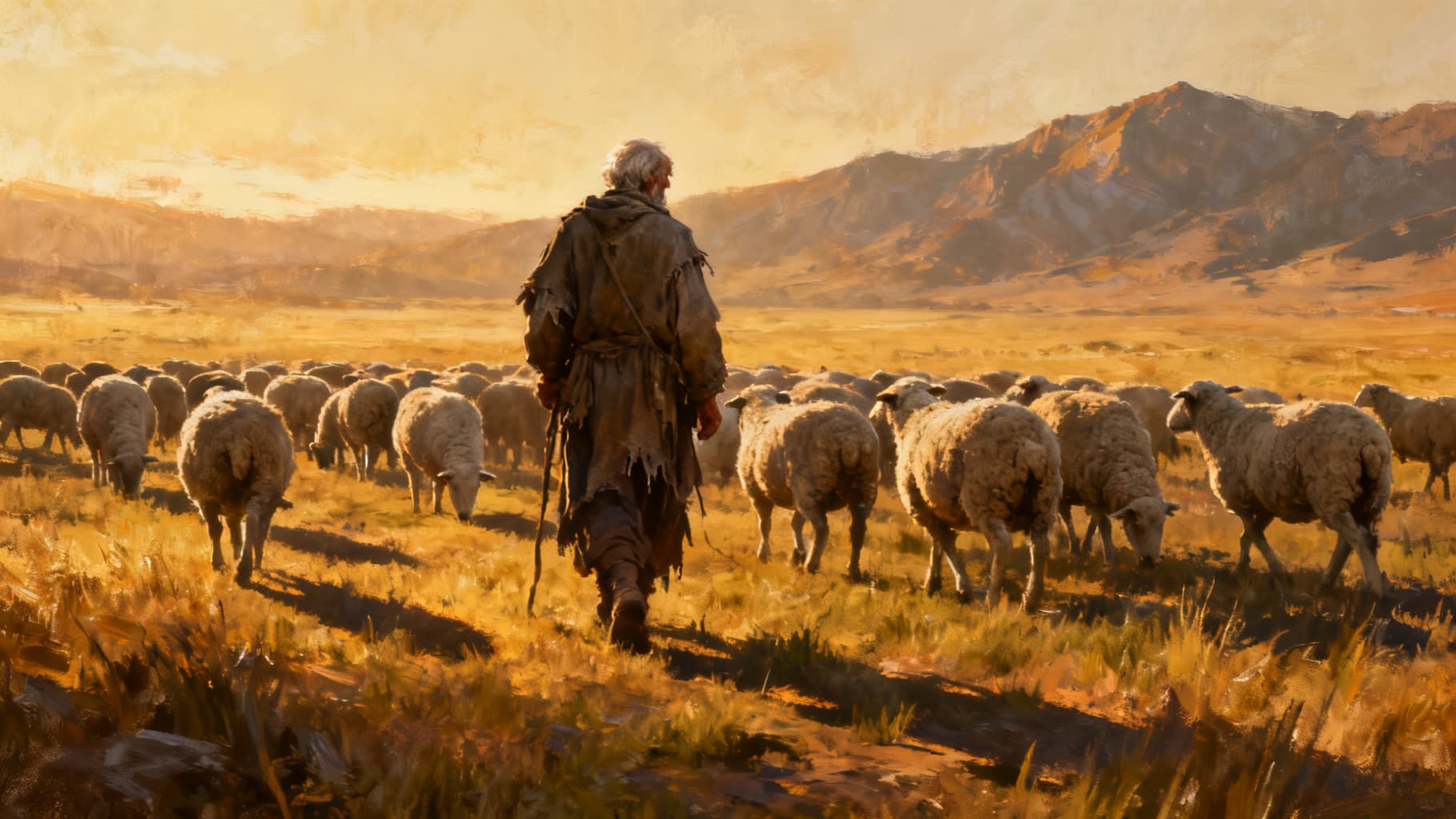
The Prince Becomes a Shepherd
Holy Ground and a Reluctant Yes
Exodus 3 · Exodus 4
“God said to Moses, ‘I AM WHO I AM. This is what you are to say to the Israelites: I AM has sent me to you.’”
— Exodus 3:14 (NIV)
By Exodus 3, Moses’ story looks finished. The Hebrew baby rescued from the Nile, raised in Pharaoh’s court, has long since fled to Midian after a killing he couldn’t undo. For forty years he has shepherded another man’s flocks, married Zipporah, a Midianite woman, and settled into the obscurity of a foreigner far from the empire he left behind. The call, when it comes, interrupts the most ordinary of days.
A bush burns without being consumed, and Moses turns aside to look. That turning aside matters: revelation often waits on the margins of our routines for someone willing to stop and pay attention. And the first instruction is not a task but a posture — “take off your sandals, for the place where you are standing is holy ground.” Before Moses is sent, he is summoned to reverence.
Then God speaks His purpose plainly: He has seen the misery of His people, heard their cries under slavery, and come down to deliver them out of Egypt. The God of the burning bush is not detached; He is a liberator who hears the groaning of the oppressed and moves toward them — and He intends to do it through a reluctant, exiled shepherd.
Moses answers with a string of objections that are achingly familiar. “Who am I?” Who are You — what is Your name? What if they don’t believe me? I have never been eloquent; I am slow of speech. And finally, the honest heart of it: “Please send someone else.” His résumé of inadequacy is long, and much of it is accurate.
God’s replies refuse to play on Moses’ terms. To “who am I?” He answers not with reassurance about Moses but with “I will be with you.” To “what is Your name?” He gives the staggering self-disclosure, “I AM WHO I AM” — the God who simply is, uncreated, sufficient, present tense. Moses’ inadequacy was never the real issue, because his adequacy was never the plan. The presence of I AM is the qualification.
There is comfort here for everyone who has felt unfit for what God seems to be asking. The call does not depend on our competence, our clean past, or our confidence; it depends on the One who calls. Yet notice God does not remove the difficulty — Pharaoh is still Pharaoh, the task is still enormous. He removes the loneliness, not the cost.
Moses finally goes. Not because his fears were answered point by point, but because the great I AM had stooped to a desert bush and promised to go with him. That is still how God works: meeting us on ordinary ground, calling it holy, and turning our reluctant yes into the beginning of someone else’s freedom.
The Big Idea
God’s call rarely waits until we feel adequate, and He seldom argues us out of our excuses — He simply offers Himself. The presence of I AM, not our competence, is the real qualification; He removes the loneliness, not the cost.
Reflect & Discuss
- 1.Where might God be speaking in the margins of an ordinary routine you’re too busy to turn aside and notice?
- 2.Which of Moses’ excuses — “who am I,” “I’m not able,” “send someone else” — is most truly yours?
- 3.What does it change to know God answered inadequacy not with a pep talk but with His presence?
- 4.Is there a place of oppression or need where God may be asking you to be part of someone else’s deliverance?
A Prayer
I AM, You meet us on ordinary ground and call it holy. I bring You my excuses and my real inadequacy, and I hear You answer not with flattery but with Yourself — “I will be with you.” Give me reverence to take off my sandals and courage for a reluctant yes. Send me toward the people You long to set free. Amen.
Talk It Through
Chat about The Prince Becomes a Shepherd and receive Scripture-based encouragement rooted in this story.
Ask anything about this story to get started.
This AI guide offers encouragement, not counseling, and can make mistakes, so always test what you read against Scripture.
Emergency: call 911, or call/text 988.
Journey Through the Bible
Stop 13 of 83
Up next: Covered by the Lamb
The same story, told for…