
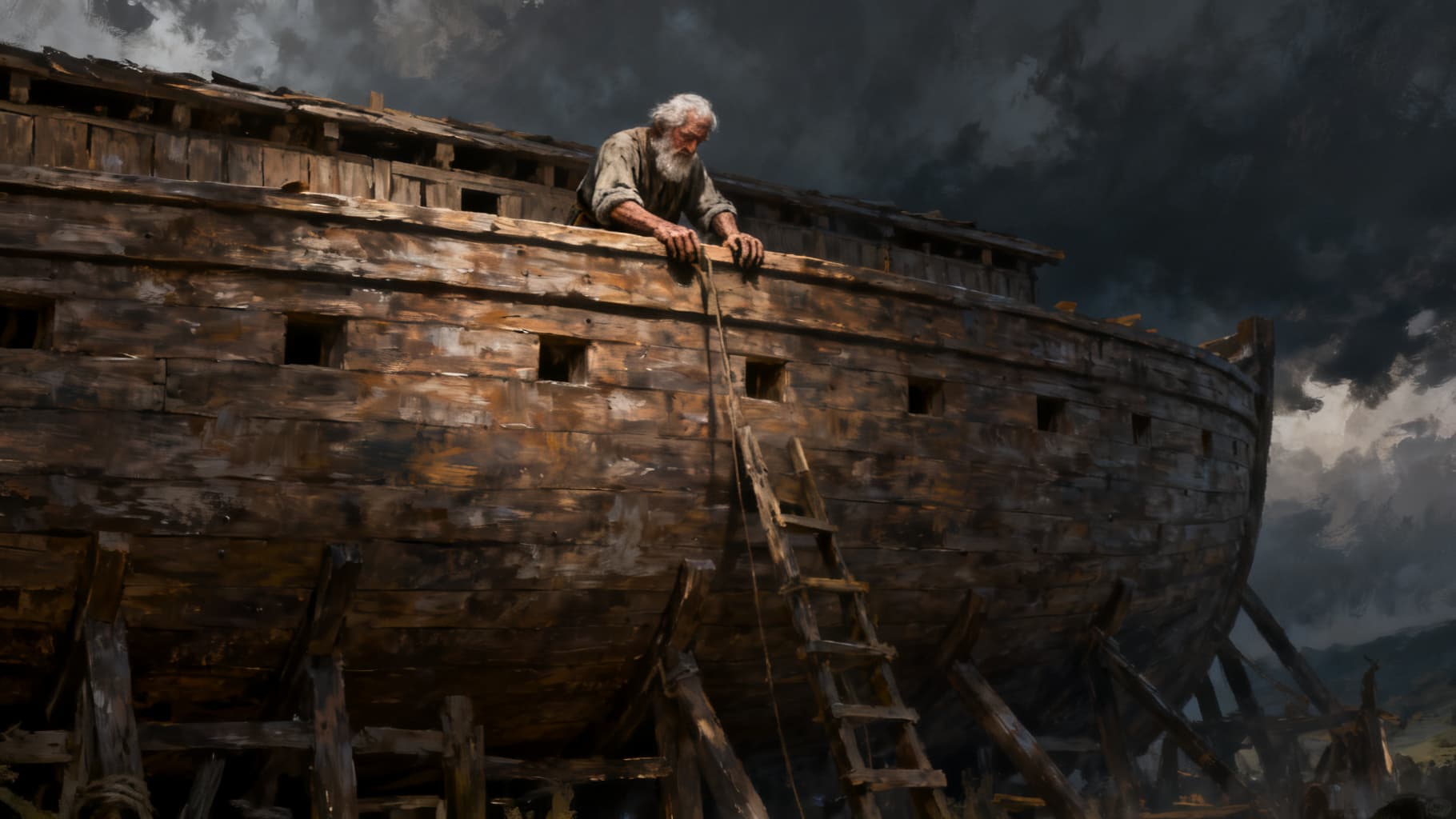
Noah and the Great Flood
Faithful in a Faithless World
Genesis 6 · Genesis 7 · Genesis 8 · Genesis 9
“But I will establish my covenant with you, and you will enter the ark.”
— Genesis 6:18 (NIV)
The flood narrative opens with a sobering verdict on an entire civilization: the earth was “full of violence,” and human imagination had bent itself “only evil all the time.” Genesis is unflinching that this is a story of judgment — and equally unflinching that one man, in the middle of that decay, “walked faithfully with God.” The contrast is the whole point.
Noah’s righteousness is not painted as moral perfection but as faithful direction — a life oriented toward God while everything around it pointed elsewhere. That is a quieter and more demanding kind of holiness than we often imagine: not retreating from a corrupt world, but remaining faithful inside it, when the surrounding culture has made his convictions look obsolete.
God’s command requires a staggering act of trust. Build an ark for a flood no one has witnessed, on the strength of God’s word alone. And then comes the part Scripture quietly underlines: Noah simply did it. “Noah did everything just as God commanded him.” There is no recorded argument, no demand for a sign — only obedience that took years to complete.
We should sit with that span of time. The ark was not built in a weekend of inspiration; it was the long obedience of a man who kept working before there was a single cloud on the horizon. Most faithfulness looks like this — unglamorous, unverified, sustained across seasons when no evidence has yet arrived to prove we were right to obey.
We must not soften the judgment, but neither should we miss the mercy threading through it. The same God who sends the waters also gives the blueprint for rescue, shuts the door Himself, and remembers Noah when the world has gone silent. Judgment and grace are not rivals here; the ark is grace standing in the middle of judgment, a refuge God provides before the storm He warned about.
When the waters recede, God does not merely return things to normal — He binds Himself by covenant. He sets His bow in the clouds, a sign aimed, as it were, back at heaven, a self-imposed promise that He will never again destroy the earth this way. The God of the flood is also the God who commits Himself, in writing, to patience with a world still capable of evil.
For adults living in our own anxious age — tempted to despair at the culture, or to quietly assimilate to it — Noah offers a third way: faithful, patient, working at the slow obedience God has actually given us, while trusting the One whose final word over the wreckage is not judgment but a rainbow. That covenant points forward to a deeper mercy still, secured not by an ark but by a cross.
The Big Idea
Faithfulness in a faithless world is rarely dramatic — it’s the long, unverified obedience of building what God asked before the proof arrives. Hold both the judgment and the grace, and trust the God whose last word is a covenant of mercy.
Reflect & Discuss
- 1.Where is the surrounding culture quietly making your convictions feel obsolete — and how are you tempted to either retreat or assimilate?
- 2.What is the ‘ark’ God has asked you to keep building with no proof yet that it matters?
- 3.How do you hold the reality of judgment and the reality of grace together without flattening either?
- 4.Where do you most need to trust that God ‘remembers’ you in a season that has gone silent?
A Prayer
Father, in a world that has lost its way, make me faithful where You have placed me — neither retreating in fear nor blending in to belong. Give me the patience for long obedience, before any proof comes. Help me hold Your judgment and Your grace together, and to rest in the covenant whose final word is mercy. Amen.
Talk It Through
Chat about Noah and the Great Flood and receive Scripture-based encouragement rooted in this story.
Ask anything about this story to get started.
This AI guide offers encouragement, not counseling, and can make mistakes, so always test what you read against Scripture.
Emergency: call 911, or call/text 988.
Journey Through the Bible
Stop 4 of 83
Up next: From Babel to Pentecost
The same story, told for…