
The Plagues and the Passover
Covered by the Lamb
Exodus 7 · Exodus 11 · Exodus 12
“I will free you from being slaves… and will redeem you with an outstretched arm.”
— Exodus 6:6 (NIV)
The Exodus opens with a cry. A whole people has been ground down by Egypt’s machinery of forced labor, and they groan under it — and the text insists that God hears, remembers His covenant, and is moved to act. Before any plague falls, the decisive fact is established: God is not indifferent to the suffering of the oppressed.
Against that cry stands Pharaoh, who embodies empire itself — its arrogance, its theology, its conviction that power is its own justification. “Who is the Lord, that I should obey him?” he asks. The conflict that follows is not merely a contest of wills but a confrontation between the living God and the gods of an oppressive state.
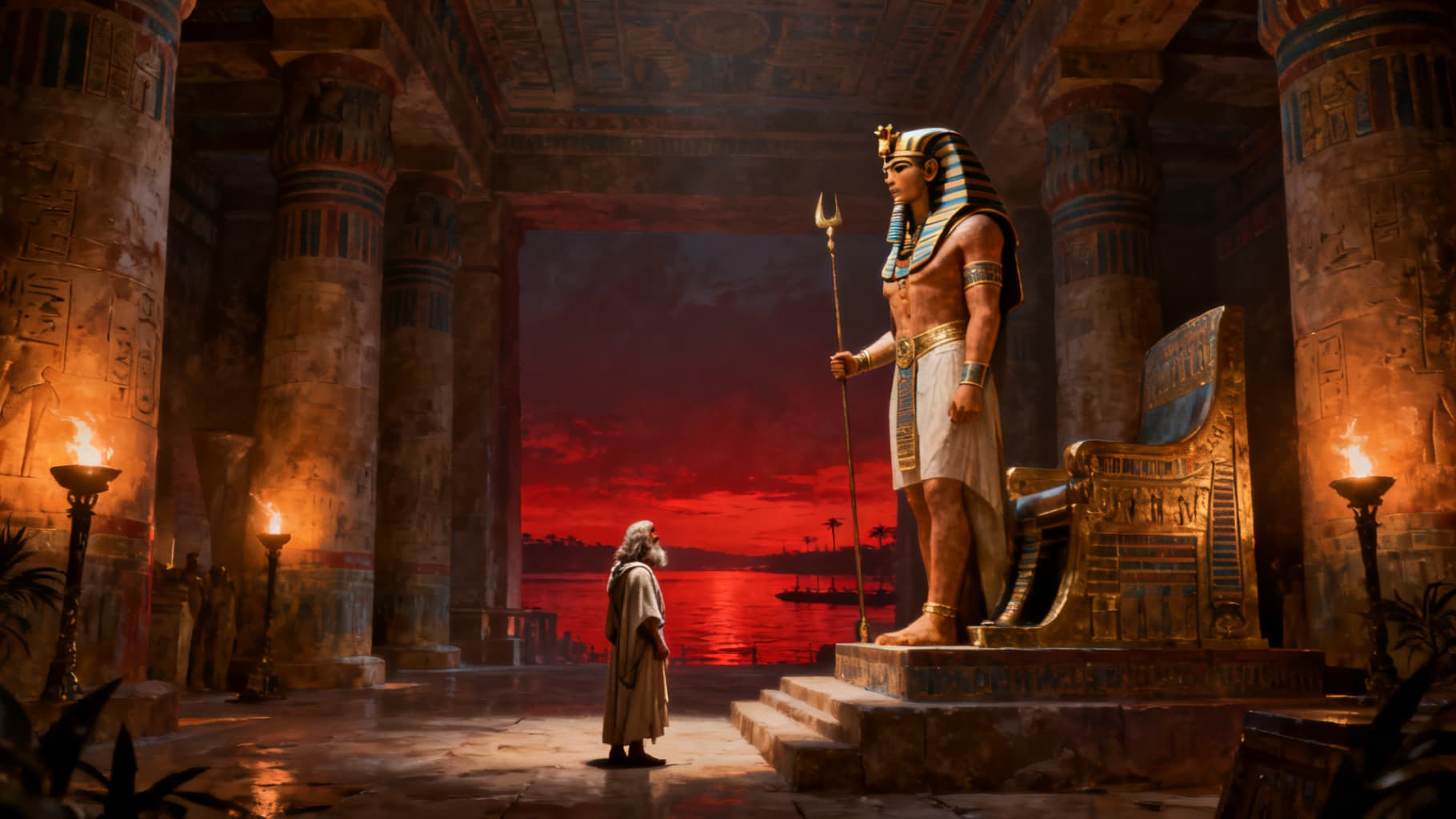
The plagues are best read as a systematic dismantling of Egypt’s pantheon. The Nile that Egypt deified turns to blood; the sun it worshiped is blotted out in darkness; the livestock it venerated falls. Each judgment exposes a false god as powerless, declaring that the idols propping up an unjust order cannot save it.
Threaded through the narrative is the sobering motif of the hardened heart — sometimes Pharaoh hardening his own, sometimes God hardening it further. It is a hard doctrine, but an honest one: persistent refusal of the truth can calcify into an incapacity to repent. Pride, left unchecked, becomes its own judgment, willing to ruin everything rather than relent.
Then the heart of it: the Passover. Israel is not spared because Israel is innocent; Israel is spared because a lamb dies in the household’s place and its blood marks the door. “When I see the blood, I will pass over you.” This is substitution — life given for life, judgment satisfied and turned aside by an appointed sacrifice — and it becomes the founding act and annual memory of the nation.
The New Testament reaches straight back here. Christ is named “our Passover lamb,” the Lamb of God whose blood does for us eternally what the lamb’s blood did that night: judgment passes over those who are covered. The doorpost points to the cross; the meal eaten in haste anticipates a deliverance from a deeper bondage than Egypt.
It is no accident that this story became the bedrock of the Black church’s liberation theology — the conviction, sung through slavery and on through the freedom struggle, that the God of the Exodus hears the enslaved and brings them out. For us today it holds both truths together: God judges oppressive powers and their idols, and He redeems a covered people by the blood of the Lamb — and He is still doing both.
The Big Idea
The God of the Exodus hears the oppressed and topples the idols of unjust power — and He redeems His people not by their merit but by the blood of a substitute. The Passover lamb points to Christ: judgment passes over all who are covered by Him.
Reflect & Discuss
- 1.Where do you need to recover the truth that God genuinely hears and acts on behalf of the oppressed — and what does that ask of you?
- 2.Which ‘gods’ of our own cultural order does this story expose as powerless to save?
- 3.Where might a hardened heart be quietly forming in you — a place where you’d rather double down than repent?
- 4.What does it mean for your daily life that you are spared by being covered by the Lamb, not by your own innocence?
A Prayer
Lord God of the Exodus, You hear the cry of the oppressed and You break the power of every false god that props up injustice. Guard my heart from the hardness of pride, and keep me quick to repent. Thank You for the Lamb whose blood covers me — for Christ, our Passover. Let judgment pass over me, and make me a person who longs, as You do, to set the captive free. Amen.
Talk It Through
Chat about The Plagues and the Passover and receive Scripture-based encouragement rooted in this story.
Ask anything about this story to get started.
This AI guide offers encouragement, not counseling, and can make mistakes, so always test what you read against Scripture.
Emergency: call 911, or call/text 988.
Journey Through the Bible
Stop 14 of 83
Up next: The Lord Will Fight for You
The same story, told for…