
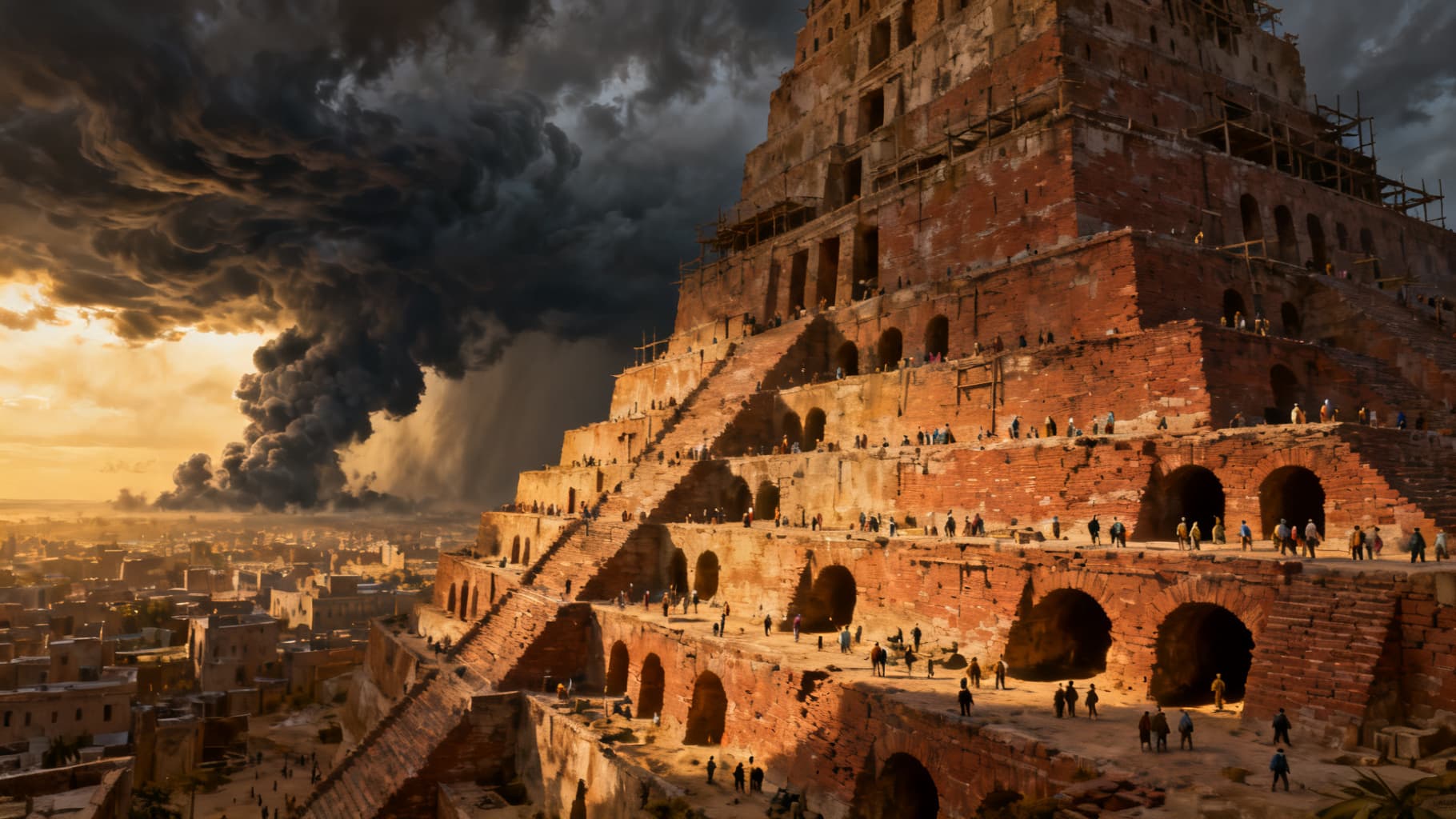
“Come, let us make a name for ourselves; otherwise we will be scattered over the face of the whole earth.”
— Genesis 11:4 (NIV)
Genesis 11 opens with a unity that sounds like strength: one language, one people, one shared ambition. They migrate to a plain in Shinar, settle, and resolve to build — a city and a tower “that reaches to the heavens.” But the narrative quickly exposes the heart beneath the project. The stated aim is twofold: “let us make a name for ourselves,” and “otherwise we will be scattered.” This is unity organized around self-glory and self-protection rather than around God.
The sin of Babel is not engineering or culture or even ambition as such; it is pride that builds a monument to its own name and self-sufficiency that needs no God. After the flood, God had renewed the creation mandate to “fill the earth.” Babel is humanity’s counter-program: stay put, consolidate, reach heaven on our own terms, and secure our reputation against the One who alone gives names. It is the architecture of a heart that wants to ascend to God’s place without bowing before God’s face.
There is a deliberate, almost satirical contrast in the telling. They build a tower meant to pierce the heavens, and the text says “the Lord came down to see” it — as if the proudest height humanity could raise was still so far below Him that He had to descend to inspect it. The verdict is not panic but sovereign ease. Human grandeur, measured against God, is never as tall as it imagines.
God’s response is to confuse their language and scatter them across the earth — and the place is named Babel, “confusion.” It is genuine judgment on pride. Yet even the judgment serves the original blessing: the scattering they dreaded becomes the means by which the earth is filled, and the nations, languages, and cultures God intended come into being. Divine judgment and divine purpose are not at odds; God bends even our rebellion back toward His design.
This is why Pentecost in Acts 2 must be read against Babel. At Babel, one language fractures into many as judgment on a people exalting their own name. At Pentecost, the Spirit descends and the many languages are suddenly understood — not erased, but gathered — as Galileans declare “the wonders of God” and people from every nation hear in their own tongue. Babel scatters around the name of man; Pentecost gathers around the name of Jesus.
That is the deep reversal. Babel’s unity was counterfeit, forged by sameness and self-glory and doomed to collapse. Pentecost’s unity is real, the Spirit creating one people out of every tongue without flattening their differences — the first fruits of the multiethnic, multilingual church. The cure for Babel was never uniformity; it was a new center. When the name being exalted is His and not ours, diversity becomes harmony instead of confusion.
And Scripture follows that thread to its end. In Revelation 7, John sees “a great multitude that no one could count, from every nation, tribe, people and language,” standing before the throne and the Lamb in worship. The languages scattered at Babel return at last — not to make a name for themselves, but to magnify the name of the One worthy of it. The tower we could not finish, God completes in the worship of the redeemed.
The Big Idea
Babel is every attempt to make a name for ourselves and reach heaven on our own terms — pride that ends in scattering and confusion. Pentecost reverses it: the Spirit gathers every tongue not around our name but around the name of Jesus. The cure for Babel is not uniformity but a new center — and it ends in the every-tongue worship of Revelation 7.
Reflect & Discuss
- 1.Where in your life — your work, reputation, or legacy — are you quietly building to “make a name for yourself”?
- 2.How does the image of God having to “come down” to even see the tower reframe your sense of your own achievements?
- 3.Where have you mistaken sameness for unity, and what would Spirit-made unity-in-difference look like instead?
- 4.What would it mean to let your gifts and ambitions be gathered around the name of Jesus rather than your own?
A Prayer
Lord, I confess how easily I build toward my own name, securing my reputation and reaching for heaven on my own terms. Forgive the pride that needs no God. Thank You that at Pentecost You came down not to scatter but to gather, uniting every tongue around the name of Jesus. Tear down the towers I’ve built to myself, and make me one small part of the multitude from every nation that will worship before Your throne. Amen.
Talk It Through
Chat about The Tower of Babel and receive Scripture-based encouragement rooted in this story.
Ask anything about this story to get started.
This AI guide offers encouragement, not counseling, and can make mistakes, so always test what you read against Scripture.
Emergency: call 911, or call/text 988.
Journey Through the Bible
Stop 5 of 83
Up next: Credited as Righteousness
The same story, told for…