
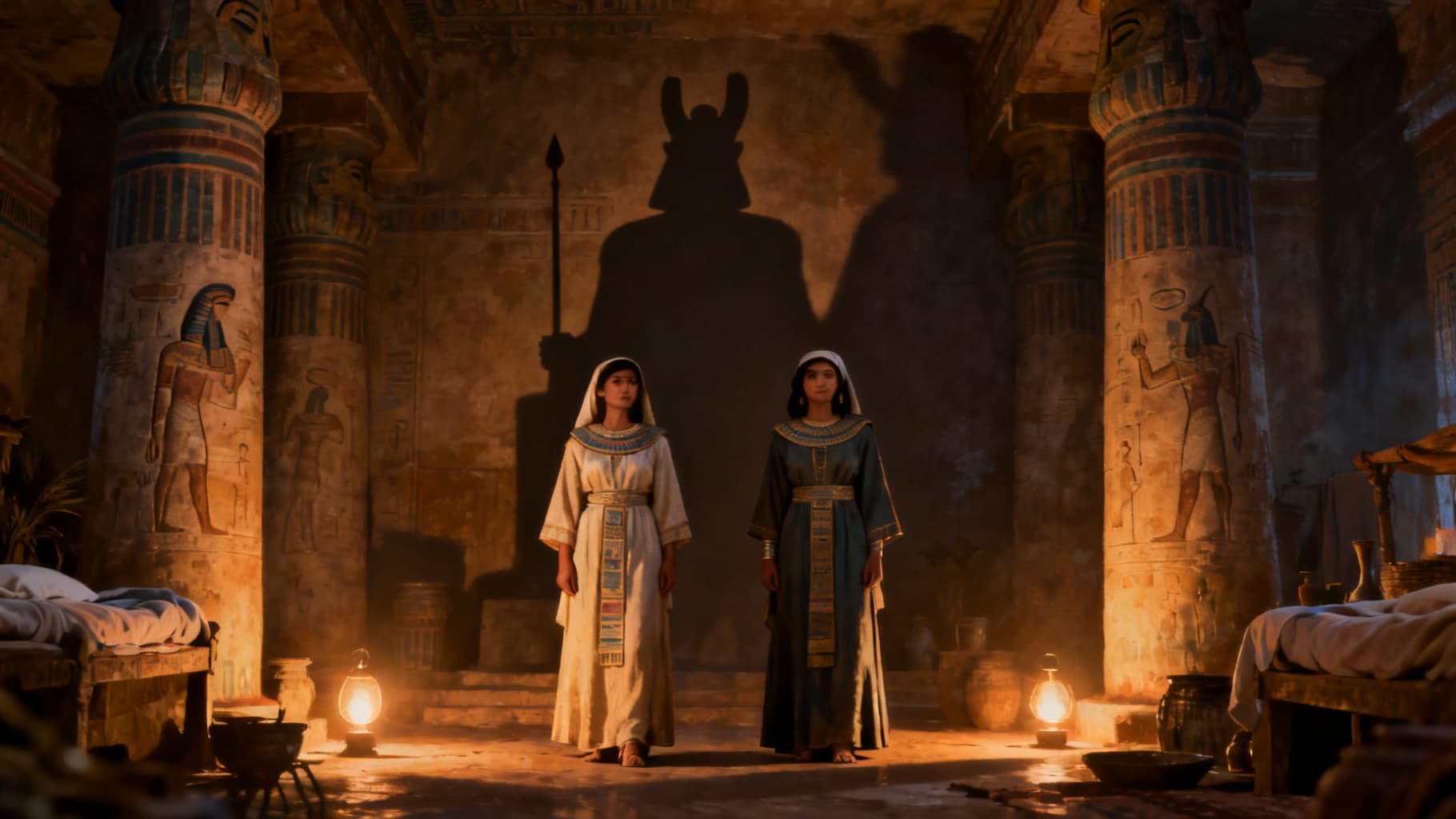
“She named him Moses, saying, ‘I drew him out of the water.’”
— Exodus 2:10 (NIV)
The book of Exodus opens in deep shadow. The descendants of Jacob have multiplied in Egypt, and a new Pharaoh, ‘who did not know Joseph,’ reads their flourishing as a threat. The response is the machinery of empire turned against a vulnerable people: forced labor, escalating cruelty, and finally a campaign of state-sponsored infanticide. Into this Moses is born — and from the start his story is set in Africa, in Egypt, the land where the deliverance of Israel will be quietly incubated.
Notice where God is in chapter one: seemingly absent. There are no miracles, no thundering voice, no angelic armies. There is only the relentless logic of power — and against it, the small, costly defiance of two women. The Hebrew midwives, Shiphrah and Puah, are named in Scripture while Pharaoh, the supposed god-king, is not. They ‘feared God’ more than they feared the throne, and they refused to kill. The first act of resistance in the Exodus is not a plague but a conscience.
The pattern continues with Moses’ mother, Jochebed. The text quietly subverts Pharaoh’s decree: he commanded that every boy be thrown into the Nile, and she places her son into the Nile — but in a sealed basket, an ‘ark,’ the same Hebrew word used for Noah’s vessel of salvation. What the empire meant as an instrument of death becomes, in her hands and God’s, a vessel of rescue. Faith here is not passive waiting; it is shrewd, tender, defiant action.
Then providence does its quiet work. Of all the people who might have found that basket, it is Pharaoh’s own daughter — an Egyptian woman of the ruling house — who draws the child from the water and is moved with compassion. The deliverer of the Hebrews is preserved by the very household that sought his destruction, and funded by its treasury. Miriam, watching, brokers the arrangement so that Moses’ own mother is paid to nurse him. God writes salvation history through the courage of women whom the powerful never thought to fear.
And so Moses is raised between two worlds. In his earliest, formative years he is nursed by his Hebrew mother, rooted however briefly in the story and faith of his people; then he is handed over to the palace, named by an Egyptian princess, and educated as an Egyptian prince. He will spend his life negotiating that double identity — Hebrew and Egyptian, slave-people and ruling class, insider and outsider — until the day he must choose which story is truly his.
We should resist sentimentalizing this. The danger was real, many other mothers’ sons were not spared, and the same providence that preserved Moses did not, in that moment, end the slavery. The text does not promise that God always intervenes visibly or rescues every child. What it shows is that God is at work beneath the surface of catastrophe — through ordinary, courageous people — long before He acts in the open. The God of the burning bush is already the God of the reeds.
For adults who have learned that the world is not safe and that injustice often holds the levers of power, this is a sober and steadying word. Providence is rarely loud. It usually looks like a midwife’s quiet ‘no,’ a mother’s desperate ingenuity, a sister’s nerve, an enemy’s unexpected compassion. God incubates deliverance in hidden places and unlikely hands — and the beginnings He guards may be carrying more than we can yet see.
The Big Idea
God’s providence is usually quiet, working through ordinary acts of courage long before any visible rescue. Trust that He is at work beneath the surface of injustice — and honor the unsung people through whom He moves.
Reflect & Discuss
- 1.Where in your own life or community might God be working unseen, beneath circumstances that look like only loss?
- 2.Shiphrah and Puah feared God more than power. Where is your conscience being tested by what’s ‘expected’ of you?
- 3.How do you hold together the truth that God preserved Moses and yet did not, in that moment, spare every child or end the slavery?
- 4.Moses lived between two worlds. How has your own divided or layered identity been used — or could be used — by God?
A Prayer
Father, when injustice seems to hold all the power and You seem silent, remind me that You are already at work in the reeds — through small acts of courage and unlikely hands. Give me the quiet defiance of those who fear You more than they fear the throne. Help me trust Your hidden providence with the beginnings, the people, and the outcomes I cannot control. Amen.
Talk It Through
Chat about The Prince From the River and receive Scripture-based encouragement rooted in this story.
Ask anything about this story to get started.
This AI guide offers encouragement, not counseling, and can make mistakes, so always test what you read against Scripture.
Emergency: call 911, or call/text 988.
Journey Through the Bible
Stop 12 of 83
Up next: Holy Ground and a Reluctant Yes
The same story, told for…