
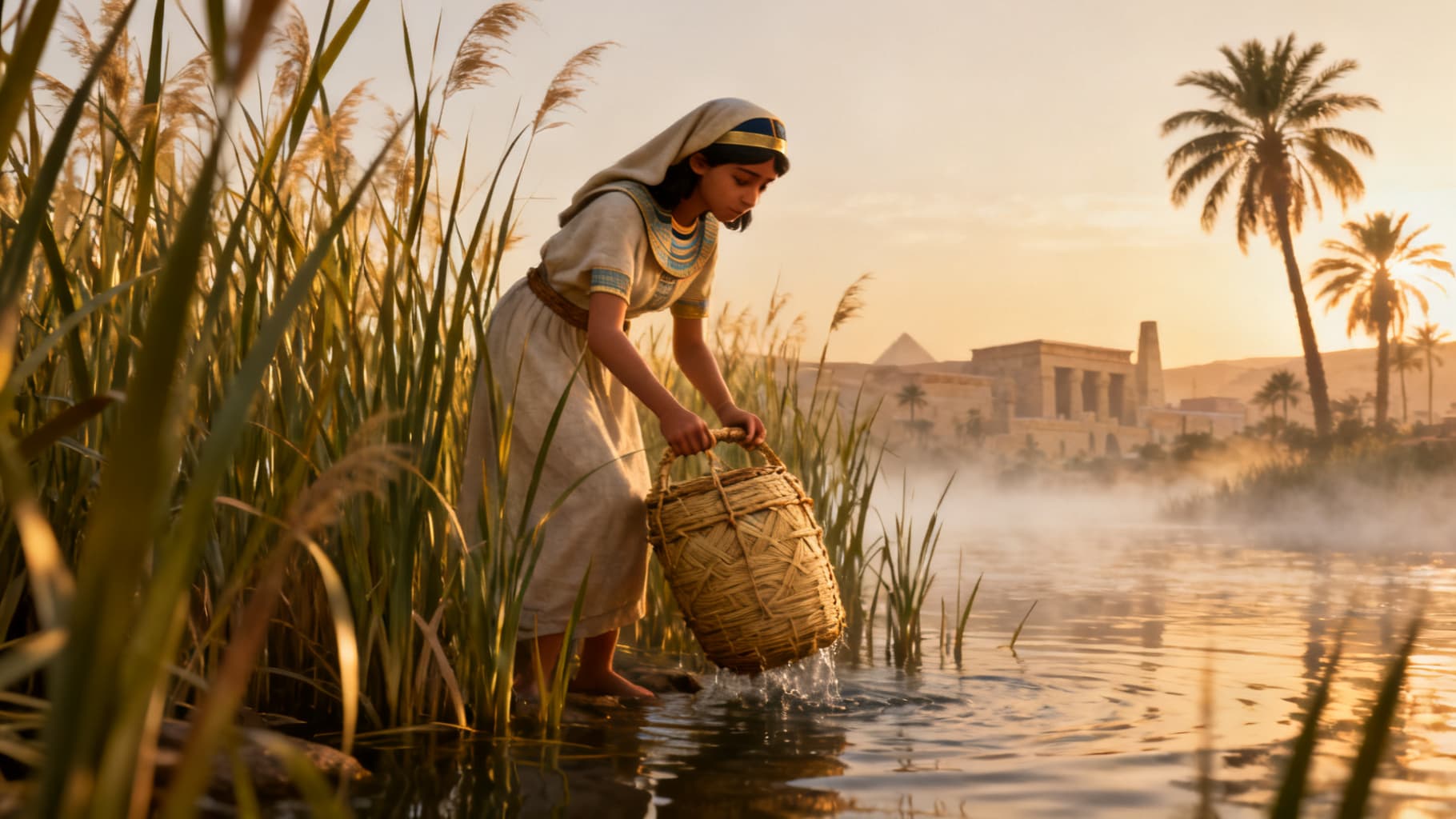
“She named him Moses, saying, ‘I drew him out of the water.’”
— Exodus 2:10 (NIV)
Moses was born into a situation he didn’t choose and couldn’t control. The Hebrews were enslaved in Egypt, the king felt threatened by how many of them there were, and he gave a brutal order: every Hebrew baby boy was to be killed. That’s the world Moses was born into — a kid whose existence was illegal before he ever did anything.
But the order ran into a wall of quiet, stubborn courage — and it was women who built it. First the Hebrew midwives, Shiphrah and Puah, simply refused to carry out the king’s command. They didn’t hold a rally; they just declined to be part of the evil, and the Bible says God was good to them for it. Ordinary women, no platform, deciding the most powerful man in the world was wrong.
Then there’s Moses’ mother. She hid her baby as long as she could, and when she couldn’t hide him anymore, she didn’t give up — she got creative. She waterproofed a basket, laid him in it, and set him in the reeds of the Nile. And his sister Miriam, probably barely older than you, stationed herself nearby to watch over him and stay ready.
Here’s where God’s hidden hand shows up. The one person who finds the basket is Pharaoh’s own daughter — an Egyptian princess, part of the very family trying to wipe these babies out. She has compassion on him. And quick-thinking Miriam steps up and offers to find a nurse for the baby — then brings back the baby’s actual mother, who now gets paid to raise her own son. You couldn’t script it. God wove the rescue right through the household of the enemy.
So Moses grows up between two worlds. He’s Hebrew by blood and birth, raised by his own mother in his earliest years — but he’s also a prince of Egypt, educated in the palace, an insider in a culture that wasn’t fully his. That tension of belonging to two places, never feeling 100% “from” either one, would shape everything he became. If you’ve ever felt like you live between worlds — two cultures, two homes, two versions of yourself — Moses gets it.
Your beginning doesn’t get the final word. Moses didn’t choose his family, his danger, or his circumstances — and neither did you. But the same God who guided a basket through the reeds and into exactly the right hands has been at work in your origin story too, even the chaotic parts, even the parts that felt random. Your start is not your sentence. God’s hand was on your beginning, and it’s still on you now.
The Big Idea
You didn’t pick your beginning, but God was already at work in it. The same hidden hand that guided baby Moses through the reeds is on your story — your start doesn’t get to decide your destiny.
Reflect & Discuss
- 1.What parts of your own beginning or background do you wish you could change?
- 2.Where do you see ‘unsung’ courage — people quietly doing right with no audience — in your life?
- 3.Have you ever felt like you live between two worlds or identities? How does Moses’ story speak to that?
- 4.If God’s hand was on your beginning, how does that change the way you see your future?
A Prayer
God, I didn’t choose how my story started, and some of it has been hard. Thank You that You were already at work in it — guiding things I couldn’t see, putting people in the right place at the right time. Help me trust that my beginning isn’t my limit, and that Your hand is still on my life. Amen.
Talk It Through
Chat about The Prince From the River and receive Scripture-based encouragement rooted in this story.
Ask anything about this story to get started.
This AI guide offers encouragement, not counseling, and can make mistakes, so always test what you read against Scripture.
If something is weighing on you, please also talk with a parent, pastor, or trusted adult.
Emergency: call 911, or call/text 988.
Journey Through the Bible
Stop 12 of 83
Up next: Who Am I to Do This?
The same story, told for…